International Plant Health Day - May 12
A reminder that protecting plant life is inseparable from protecting food security, biodiversity, climate resilience, and the future sustainability of rural communities..... Read More
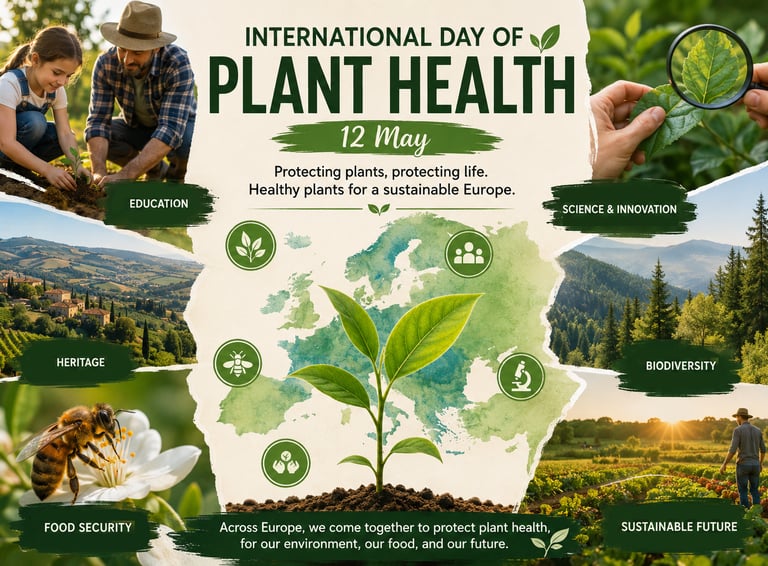
Today, communities, researchers, farmers, educators, environmental organizations, and policymakers across Europe mark International Day of Plant Health — a reminder that protecting plant life is inseparable from protecting food security, biodiversity, climate resilience, and the future sustainability of rural communities. The annual feastday is celebrated in remarkably diverse ways, reflecting the many environments and cultures connected through plant health.
In Mediterranean regions, activities highlighted the growing pressures facing olive groves, vineyards, citrus ecosystems, and traditional agricultural landscapes increasingly threatened by drought, invasive pests, soil degradation, and climate instability. Educational workshops and local awareness campaigns focused on sustainable farming, biodiversity preservation, and the protection of native species that shape regional identity and food systems.
In Nordic and Baltic countries, the conversation often centered on forests, pollinators, sustainable land management, and the resilience of ecosystems already experiencing the visible impacts of climate change. Schools, environmental groups, and research institutions used the occasion to engage younger generations in discussions about biodiversity loss, ecosystem balance, and the importance of healthy forests and soils to both environmental and economic sustainability.
Elsewhere throughout Central and Eastern Europe, rural communities and agricultural stakeholders highlighted the critical relationship between plant health and rural livelihoods. Traditional farming systems, local food production, seed diversity, and sustainable land stewardship remain essential not only for food production, but for maintaining cultural heritage, regional economies, and social cohesion within rural territories increasingly facing depopulation and environmental pressures.
International Day of Plant Health also serves as an important reminder that plant health is not solely an agricultural issue. It is deeply connected to:
• climate resilience,
• water systems,
• biodiversity,
• tourism landscapes,
• human health,
• and economic stability.
Healthy plants sustain ecosystems that support pollinators, stabilize soils, capture carbon, reduce erosion, and provide the landscapes that define so many of Europe’s rural identities and visitor experiences. Increasingly, Europe’s green transition depends not only on technological innovation, but on restoring and protecting the ecological foundations upon which communities and economies depend.
One of the most encouraging aspects of annual celebrations is the growing involvement of schools, youth initiatives, citizen science projects, and local communities. Across Europe, environmental literacy is becoming more participatory, experiential, and community-rooted — helping younger generations understand that sustainability is not an abstract policy objective, but something directly connected to landscapes, livelihoods, and daily life.
As Europe continues navigating the twin green and digital transition, protecting plant health will remain central to achieving resilient food systems, sustainable rural development, biodiversity protection, and climate adaptation.
Protecting plant health ultimately means protecting the ecosystems — and communities — that sustain us all.
#PlantHealthDay #InternationalDayOfPlantHealth #Sustainability #Biodiversity #ClimateResilience #RuralDevelopment #GreenTransition #FoodSecurity #EnvironmentalEducation #Agriculture #NatureBasedSolutions #Europe #SustainableFuture
Ruralities Living Lab for Resilient Rural Communities
Sustainability in Rural Enterprises and Innovation
A member of the Social Innovation Stakeholders Network - www.SocialInnovationActions.Org
Social Innovation Actions - PIC 878506012