Restoring the Vitality of Europe's Rural Territories
Europe’s rural future can only be rebuilt through talent, connectivity, entrepreneurship, and a new understanding of what rural territories can become. Across Europe, thousands of villages share the same story: Once vibrant communities - Now shrinking populations..... Read More
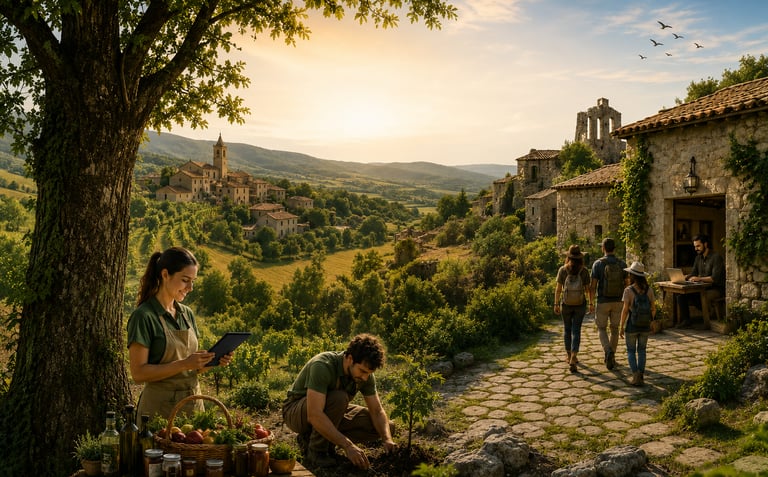
Europe’s rural future can only be rebuilt through talent, connectivity, entrepreneurship, and a new understanding of what rural territories can become. Across Europe, thousands of villages share the same story: Once vibrant communities - Now shrinking populations. Young people are leaving, schools are closing, family farms are being taken over by large corporations, and local "knowledge of the land" is fading quietly with each generation.
But what if rural decline is not the end of the story? We believe dispersion is reversible!
Rural communities are not truly lost when people leave — their identity, relationships, culture, and knowledge still exist across families, diasporas, and networks. People, talent, and economic life can return, reconnect, and renew rural territories with the right opportunities, connections, and investment. This is the starting point of RURALITIES — a transnational initiative designed to reimagine Europe’s rural interior through sustainable agrotourism, digital innovation, and community-led regeneration. At the heart of the project is a simple but powerful idea:
Rural spaces should not be understood as what remains with depopulation; they should be understood as what renews.
For decades, opportunity for investment and infrastructure concentrated around Europe’s cities while rural territories were left behind. Yet these same regions remain custodians of Europe’s agricultural heritage, biodiversity, food culture, and cultural identity. RURALITIES responds directly to the European Union’s Long-Term Vision for Rural Areas by creating local innovation ecosystems that connect rural communities to wider European networks and markets.We begin our revitalization journey with agrotourism. Why?
Because travelers are changing
More people are searching for authentic experiences rooted in place, like tasting food at its source
People want to reconnecting with heritage, nature, and slower forms of living, and explore cultural landscapes beyond crowded cities
Europe’s rural communities already possess extraordinary cultural landscapes, agricultural knowledge, food traditions, biodiversity, and human capital. What they often lack are the systems that allow young people to build modern, sustainable careers without leaving home: digital tools and business support for agrotourism and agrifood operations, international visibility, sustainability frameworks, route infrastructure — and, critically, professional development pathways. For decades, rural out-migration has been driven not by a rejection of rural life itself, but by the absence of viable professional futures. In many regions, tourism employment opportunities are concentrated almost entirely in coastal cities and resort economies, drawing young people away from inland agricultural communities toward service work elsewhere. As talent leaves, rural territories lose far more than population; they lose tax revenue, opportunities for innovation to take hold via entrepreneurship, a new generation of business owners carrying down family traditions, cultural continuity, and future caretakers for local landscapes, traditions, and family enterprises.
The result of depopulation in rural territories is a gradual erosion of community life itself.
Schools close because there are too few children with too few teachers. Family farms disappear without successors or are transferred to corporate producers. Local shops and cafés, hairdressers, tailors, florists, print shops, restaurants, etc. lose customers and shutter their doors. Elderly parents remain while younger generations disperse across cities and countries in search of work. What begins as economic migration slowly becomes social fragmentation — weakening intergenerational bonds, reducing civic participation, and diminishing the everyday vitality that once sustained rural communities.
At the same time, the economic value generated by tourism often bypasses these territories entirely. Visitors flock to Europe’s coastlines while inland communities — despite holding extraordinary heritage, culinary traditions, and agricultural experiences — remain disconnected from tourism value chains. Rural territories are, therefore, robbed twice: first of their young people, and second of the revenue streams that could help sustain local economies.
Reversing this trend requires more than preserving heritage — it requires professionalizing opportunity. That means creating pathways where rural youth can develop recognized skills in sustainable tourism management, digital marketing, creation of agri-food products, destination storytelling, hospitality innovation, and circular economy practices for in-place job creation. It means building ecosystems where young people can access training, mentorship, entrepreneurship support, and international networks without abandoning the communities they call home.
That also means creating pathways where rural youth can develop skills for remote work in areas such as digital marketing, agri-food branding, remote business services and logistics, and cultural entrepreneurship. It means connecting local operators to European learning ecosystems, mentorship, mobility programs, and digital employment networks that allow people to remain rooted in their communities while participating in modern economies.
Thus, professional development is not simply an accessory to rural regeneration — it is its foundation. When rural territories can offer meaningful careers alongside quality of life, they become places where people choose to stay, return, invest, and build families. The goal of RURALITIES is not simply to attract visitors, but to cultivate a new generation of skilled rural professionals capable of restoring economic vitality, social cohesion, and long-term resilience across Europe’s rural interior. When young people can see a future for themselves locally, rural territories shift from places of departure to places of possibility by cultivating a new generation of skilled rural professionals capable of sustaining vibrant local economies into the future. RURALITIES is not simply an agro-tourism project; it is a talent-pool strategy. One of the deepest challenges facing rural Europe is not only economic decline — it is the loss of human capital. Young people leave because too often they cannot imagine a professional future in the places they love. RURALITIES seeks to change that equation. Perhaps more importantly, municipalities are not passive participants in this process — they are central actors. Across Europe, successful rural regeneration has almost always begun locally: with mayors, councils, and communities willing to turn decline into possibility, especially in view of EU mandates for the twin transition, which can become tangible at the rural village level, and strengthening territorial identity that in turn create future-oriented rural livelihoods. Europe, however, cannot achieve resilience while its rural interior empties. The future of Europe’s countryside is not about preserving a museum of the past - it is about building a new economy of belonging.
#RURALITIES #RuralDevelopment #Agrotourism #SustainableTourism #DigitalTransition #GreenTransition #EUProjects #RuralInnovation #TourismSMEs #PlaceBasedDevelopment #RuralEurope #CommunityDevelopment
Ruralities Living Lab for Resilient Rural Communities
Sustainability in Rural Enterprises and Innovation
A member of the Social Innovation Stakeholders Network - www.SocialInnovationActions.Org
Social Innovation Actions - PIC 878506012