Rural Diversification: Why New Opportunities Emerge Where Different Worlds Meet
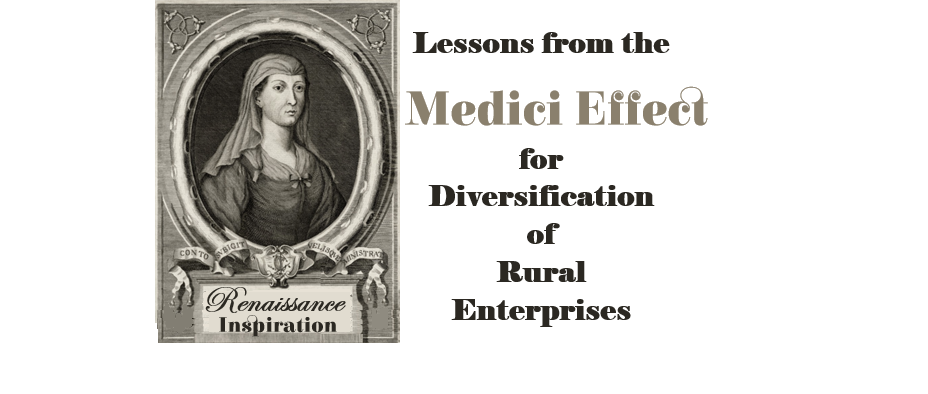
Lessons from "Medici Effect" offer insights on how diverse members of community can interact across traditional boundaries resulting in an exchange of ideas that fueled one of history's most remarkable periods of creativity, innovation, and economic development..... Read More
Across Europe, rural businesses face a common challenge: how to remain economically viable in a rapidly changing world. Traditional agricultural production continues to play a vital role, but fluctuating commodity prices, climate pressures, demographic change, and shifting consumer preferences are prompting many rural enterprises to explore new sources of income. The question is often framed as one of diversification. But perhaps the more important question is: where do new ideas come from?
The concept known as the "Medici Effect" offers an intriguing answer. Its name derives from Renaissance Florence, where the Medici family created an environment in which artists, scientists, engineers, philosophers, merchants, and craftsmen could interact across traditional boundaries. The resulting exchange of ideas helped fuel one of history's most remarkable periods of creativity, innovation, and economic development. These lessons remains highly relevant today. Innovation often emerges not within a single discipline or sector, but at the intersections where different forms of knowledge, experience, and opportunity meet. New ideas arise when people look beyond familiar boundaries and discover unexpected connections between seemingly unrelated fields.
The same principle applies to rural development. Many of the most successful examples of rural diversification emerge not from doing more of the same, but from combining existing strengths with entirely different sectors and ways of thinking. Agro/Eco/Nature tourism is a perfect example. Experience-based tourism enable visitors to engage directly with landscapes, heritage, food systems, and local communities. Rural territories increasingly benefit from niche tourism sectors that exist at the intersection of agriculture, hospitality, education, heritage, gastronomy, and visitor experience, diversifying local economies while promoting sustainability. A farm that once produced only food may also become a destination for farm stays, educational visits, culinary experiences, wellness retreats, or outdoor recreation. The same pattern can be seen elsewhere:
🐝A beekeeper combines pollinator conservation with educational tourism.
🍇A vineyard integrates wine production with cultural events and local gastronomy.
🐄A livestock producer develops renewable energy alongside agricultural production.
🌲A forestry enterprise incorporates biodiversity monitoring, nature interpretation, and ecotourism experiences.
A traditional farm creates digital storytelling content that reaches global audiences.
None of these opportunities emerge from agriculture alone. They emerge at the intersection of multiple domains. The lessons from the Medici Effect are particularly important for rural enterprises:: Innovation does not always require inventing something entirely new. Often it involves looking beyond sector boundaries and asking how existing assets, knowledge, landscapes, traditions, and skills might connect with new markets, technologies, or social needs.
In many rural communities, valuable resources already exist: local food traditions, cultural heritage, biodiversity, artisanal knowledge, landscapes, community networks, and agricultural expertise. The challenge is identifying unexpected combinations that create new value. This is where collaboration becomes essential. Diversification is often accelerated when farmers, entrepreneurs, researchers, educators, tourism operators, local authorities, and community organisations work together. Different perspectives reveal opportunities that may remain invisible within a single sector.
The future of rural resilience may, therefore, depend less on specialization and more on connection. As the Medici Effect demonstrates, innovation often emerges where different worlds meet. For rural enterprises seeking new pathways for growth, sustainability, and long-term viability, those intersections may be the most fertile ground of all.
#Ruralities #RuralDevelopment #RuralInnovation #RuralEntrepreneurship #RuralBusiness #Agrotourism #Agrifoods #BusinessDiversification #Ectourism #NatureTourism #SustainableTourism #RuralEconomy #CommunityResilience #LocalEconomies #Innovation #SocialInnovation #CrossSectorInnovation #MediciEffect #KnowledgeExchange #InterdisciplinaryInnovation #TerritorialDevelopment #RuralResilience #PlaceBasedDevelopment #CircularEconomy #Bioeconomy #FutureOfRuralEurope #SUSTAINAGRO
Ruralities Living Lab for Resilient Rural Communities
Sustainability in Rural Enterprises and Innovation
A member of the Social Innovation Stakeholders Network - www.SocialInnovationActions.Org
Social Innovation Actions - PIC 878506012