Social Readiness Becoming An Evaluation Standard
Social readiness refers to the extent to which communities, institutions, businesses, and citizens are prepared to understand, adopt, adapt, and sustain innovation. Even the most advanced solutions can fail if they are introduced into environments where trust, skills, participation, governance structures, or local ownership are lacking..... Read More
The Missing Ingredient in Rural Innovation: Why Social Readiness Matters
Across Europe, significant resources are being invested in innovation. New technologies, digital tools, sustainable farming practices, renewable energy systems, circular economy models, and climate adaptation solutions are being developed at an unprecedented pace. Yet despite their technical sophistication, many promising innovations struggle to achieve lasting impact once they reach real communities. Why? For many European research projects, innovation policy was focused on technological readiness. Researchers and policymakers developed Technology Readiness Levels (TRLs) to assess whether an innovation was mature enough to move from concept to deployment. This approach has proven valuable in evaluating technical feasibility and reducing implementation risks.
That experience across rural territories, however, is increasingly revealing a different challenge - the question is not always whether the technology is ready; the question is whether people are. This is where the concept of social readiness becomes important. Social readiness refers to the extent to which communities, institutions, businesses, and citizens are prepared to understand, adopt, adapt, and sustain innovation. Even the most advanced solutions can fail if they are introduced into environments where trust, skills, participation, governance structures, or local ownership are lacking.
In rural areas, this challenge unfolds within complex socio-ecological systems shaped by local knowledge, cultural traditions, community relationships, environmental conditions, and economic realities. Successful innovation therefore depends not only on technological excellence but also on social capacity. At SUSTAINAGRO, this understanding has emerged through practical experience with Ruralities Living Labs, citizen participation initiatives, rural entrepreneurship programs, and community-led innovation processes. Time and again, the most successful projects have been those that actively involve local actors in shaping solutions rather than simply delivering solutions to them.
Five Dimensions of Rural Social Readiness
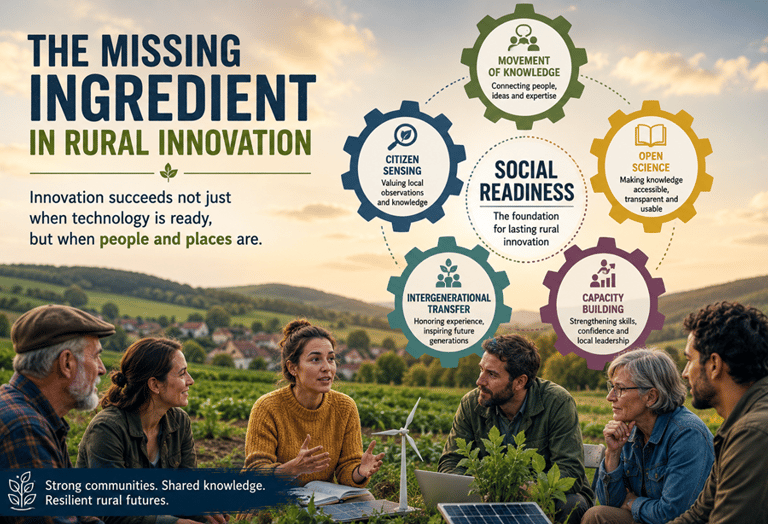
Social readiness can be understood through five interconnected dimensions.
1. Movement of Knowledge - Innovation depends on the circulation of knowledge between researchers, practitioners, businesses, policymakers, educators, and citizens. Too often, valuable knowledge remains confined within institutions, academic publications, or sector-specific networks. Rural innovation requires mechanisms that enable ideas to move freely between different actors and territories. When knowledge circulates effectively, innovation becomes more relevant, adaptable, and resilient.
2. Citizen Sensing - Recognizes farmers, entrepreneurs, residents, and community members as active contributors of local knowledge and observations that help shape innovation, research, and territorial development. Local communities possess forms of observational and practical knowledge that cannot be fully captured through surveys, datasets, or remote sensing technologies. Farmers notice subtle changes in soil conditions. Fishers observe shifts in marine ecosystems. Rural entrepreneurs identify emerging market opportunities. Residents understand local dynamics that external experts may overlook. Citizen Sensing recognizes these observations as legitimate and valuable contributions to innovation and decision-making.
3. Open Science - Knowledge generates greater value when it is accessible. All Horizon projects promote the FAIR (findable, accessible, interoperable, reusable) principle - the guidelines for managing and sharing data so that it can be effectively used by humans and machines. In rural settings, however, FAIR does not necessarily mean collecting scientific biodiversity data; it means ensuring that information generated by rural communities is structured in a way that allows it to be FACAR (findable, accessible, compared, aggregated, and reused across territories and projects). This includes sustainability practices, agro-ecological observations, tourism stewardship activities, local environmental knowledge, circular economy initiatives, and citizen-generated observations, that can contribute to wider research, innovation, and policy ecosystems. In rural contexts, therefore, Open Science helps bridge the gap between research institutions and local communities, creating opportunities for co-creation rather than one-way knowledge transfer.ur communities are ready to shape the future alongside them.
4. Intergenerational Transfer - Many rural territories face the challenge of demographic decline, ageing populations, and youth outmigration. At the same time, they possess rich reservoirs of experience, traditional knowledge, and practical expertise accumulated over generations. Social readiness depends on creating pathways through which this knowledge can be transferred, adapted, and combined with new ideas. Innovation becomes stronger when experience and fresh perspectives work together.
5. Capacity Building - Communities cannot engage effectively with innovation if they lack the skills, confidence, networks, or institutional support required to act. Capacity building strengthens the foundations that allow innovation to take root. It empowers individuals, organisations, and communities to participate actively in shaping their futures rather than simply responding to external change.
Beyond Technology
The future of rural development will undoubtedly involve technological innovation. Artificial intelligence, digital agriculture, renewable energy systems, smart villages, precision farming, and new business models all have important roles to play. Yet technology alone does not create transformation. Transformation occurs when people are prepared to engage with change, contribute their knowledge, collaborate across sectors, and build shared ownership of new solutions. In this sense, social readiness may be the missing ingredient in rural innovation.
The most successful innovations are rarely those that are simply introduced into communities. They are the ones that communities help design, test, adapt, and ultimately make their own. For Ruralities Living Labs, citizen science initiatives, community-led development programmes, and place-based innovation ecosystems, social readiness is not an optional consideration. It is the foundation upon which lasting change is built.
As Europe continues to invest in the green and digital transitions, perhaps the most important question is no longer whether our technologies are ready. It is whether our communities are ready to shape the future alongside them.
Ruralities Living Lab for Resilient Rural Communities
Sustainability in Rural Enterprises and Innovation
A member of the Social Innovation Stakeholders Network - www.SocialInnovationActions.Org
Social Innovation Actions - PIC 878506012