Turning Ideas into Long-Term Impact
The SUSTAINAGRO Academy foocuses on the strategic development of up-skilling and re-skilling the Ruralities sectoral labor market. For achieving the objectives, we have a structured set of activities grouped in five main elements that form a coherent and comprehensive project implementation process:
Design the Skills Enhancement methodology
Design micro-credential certification framework for transitional skills
Communication, dissemination, engagement and exploitability
Data Digitalization
ECO Seal Sustainability






Rural industries are undergoing rapid transformation, driven by sustainability objectives, digital innovation, climate adaptation, and changing rural economies. At the same time, skills shortages, demographic decline, and the need for new competencies continue to grow across agriculture, food production, forestry, rural tourism, and the wider bioeconomy. The SUSTAINAGRO ACADEMY directly addresses these challenges by providing a clear, structured framework that enables ruralities actors to:
Modernize operations to adapt to the EU's Twin Transition - goals for decarbonization and digitalization that include essential green, digital, entrepreneurial, and resilience skills relevant to rural industries;
Align education and skills development with evolving industry needs, EU rural policy priorities, and sustainability goals;
Ensure high-quality, future-oriented learning through accessible teaching and learning approaches such as experiential learning, living labs, AR/VR simulations, and problem-based learning;
Support rural workforce development by equipping learners with job-ready and innovation-ready skills for emerging opportunities in sustainable agriculture, circular economy enterprises, regenerative food systems, renewable energy, rural services, and smart villages.


The SUSTAINAGRO ACADEMY partners with vocational education and training institutions, secondary and higher education schools, and public body educators, advisors, and trainers to co-create practical step-by-step tools to update and enrich curricula and learning experiences that are aligned with rural industry labor market needs




These approaches are key to strengthening rural resilience and attractiveness by fostering local innovation capacity, intergenerational knowledge exchange, and community-led entrepreneurship. They contribute directly to the objectives of the green and digital transition, while supporting more inclusive, connected, and sustainable rural territories. SUSTAINAGRO welcomes partnershiips with VET providers, HEIs, research centres, local and regional authorities, and Common Agricultural Policy (CAP) and Agricultural Knowledge and Innovation Systems (AKIS) actors - the organizations, institutions, networks, and individuals involved in creating, sharing, applying, and supporting knowledge and innovation in agriculture and rural development. Everyone who helps move knowledge “from research to practice and back again” are invited to join the network: NGOs, SMEs, producer organizations, and community stakeholders join the partnership towards developing and piloting innovative learning methodologies for the future of rural industries. Partnership cooperation may include:
PARTICIPATION IN PILOT ACTIONS, LIVING LABS, AND TRANSNATIONAL LEARNING ACTIVITIES activities enables partners to test innovative approaches in real rural environments, exchange experiences across countries, and co-create practical solutions with learners, educators, businesses, and local communities. SUSTAINAGRO is an example of a Living Lab - a collaborative, real-world innovation spaces where stakeholders work together to experiment, develop, and refine new ideas, technologies, services, or educational approaches in practical settings rather than in isolated research environments.
Top Related Coursework
EN ● IT ● PT
Languages:
EN
Languages:
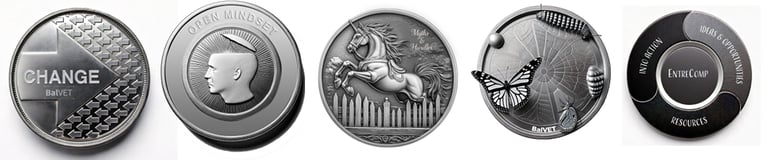
Module 1: Change Caused b y Disruption
Chapter 2: EntreComp - the EU Framework for Entrepreneurship Education
Chapter 3: The Entrepreneurial Mindset
Chapter 4: Myths & Hurdles
Chapter 5: The EU's Twin Transition
Chapter 6: Transformation
Module 1: Agrotourism Management
Module 2: Supply Chain and Value Chain
Module 3: Adapting to the Twin Transition via Digitalization
Module 4: Diversification to Maximize Profits
Module 5: Communicating Circularity
Module 6: Greenwashing
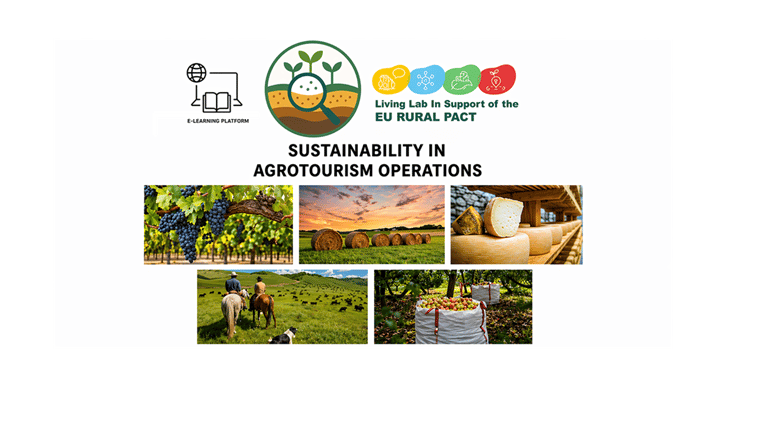
Module 7: EU Sustainable Tourism Pathway
Module 8: Sustainability Toolkit for Agrotourism Operators

Microcredentials
Pilot actions are small-scale, practical initiatives designed to test new methods, training models, technologies, or cooperation approaches before wider implementation. In the rural industries context, pilot actions may include testing innovative VET modules, digital learning tools, regenerative farming practices, circular economy solutions, community entrepreneur-ship models, or immersive learning experiences such as GeoAI, agro-voltaics, agrifood value chains, agrotourism diversification, etc. These activities are typically implemented through collaborative partnerships involving VET providers, HEIs, SMEs, rural enterprises, local authorities, NGOs, advisory services, and community stakeholders funded via multilateral funding programming from Horizon Europe, Interreg, Erasmus+, LIFE, etc. at the EU level, and national funding mechanisms at the local level. Other funding agencies include EIP-AGRI Operational Groups, LEADER/CLLD, Digital Europe, EEA/Norway, and Nordic Council for geographic-specific funding.
We are keeping an eye out for emerging funding bases such as the EU Talent Partnership These frameworks support knowledge exchange, green transition initiatives, digital innovation, inclusive rural development, and capacity building across European regions.and innovation schemes. Funding may support mobility activities, curriculum development, digital tools, workshops, demonstration sites, stakeholder engagement, and collaborative testing environments.
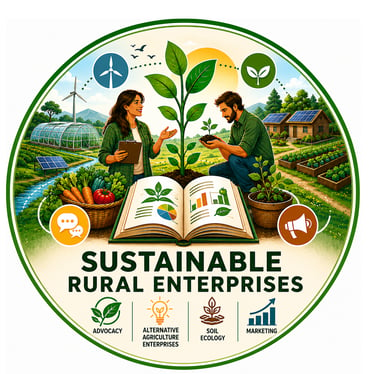
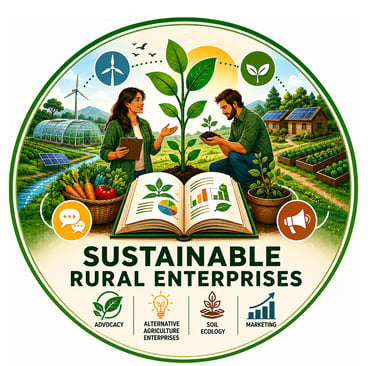
Module 1: Rural Advocacy
Module 2: Citizen Sensing for Soil Health
Module 3: Agrifoods Entrepreneurship
Module 4: Effective Marketing Strategies
Languages:
EN
The EXCHANGE OF BEST PRACTICES, TOOLS, METHODOLOGIES, and CASE STUDIES creates a dynamic environment for mutual learning and continuous improvement among partners, stakeholders, and rural communities across Europe. By sharing practical experiences, tested approaches, and locally developed solutions, partners can better understand how different regions respond to common challenges related to sustainability, digital transition, rural entrepreneurship, skills development, and community resilience. This collaborative exchange helps identify successful rural innovation models, sustainable business practices, and transferable educational methodologies that can be adapted and replicated in diverse territorial contexts. It also strengthens peer-to-peer learning between educators, researchers, SMEs, cooperatives, public authorities, advisory services, and community organizations, encouraging cross-sector collaboration and the co-creation of new ideas.


Through workshops, study visits, digital knowledge-sharing platforms, living labs, and transnational learning activities, partners can showcase innovative practices in areas such as regenerative agriculture, circular economy initiatives, smart villages, rural tourism, cultural heritage preservation, digital learning, and community-led development. The exchange process not only increases the visibility of local success stories but also supports the scaling of impactful solutions and the development of stronger rural innovation ecosystems.
By fostering openness, collaboration, and knowledge transfer, these activities contribute to building more connected, resilient, and future-oriented rural regions while reinforcing European cooperation and shared learning across territories. And by working together across sectors and regions, SUSTAINAGRO aims to build a collaborative rural innovation ecosystem that empowers people, strengthens communities, and creates sustainable opportunities for future generations.
ECO Seal
The SUSTAINAGROO ECO SEAL for rural enterprises defines a core set of baseline operational practices and processes that constitute the minimum requirements for an Eco-Rating Certification.
A flexible self-assessment constitutes the audit phase, complemented by a Sustainability Toolkit; each include supporting tools and resources that properties can use to develop and strengthen their sustainability practices. Available to Sustainagro Network members free of charge.
Grow, diversify, and future-proof operations While nurturing inter-generational Knowledge Transfer


FARM-TO-FORK
Linking soil health and ecological farming practices to premium, market-ready products
SUSTAINABLE TOURISM
E-Learning and Eco-Seal Certification for transparent environmental monitoring
HANDS-ON LEARNING
Dialogue series built at the intersection of soil science, farming, food, culture, and societal values.
SUBSCRIBE
Subscribe to our newsletter to always be the first to hear about recent news and adventures in Ruralities.
Ruralities Living Lab for Resilient Rural Communities
Sustainability in Rural Enterprises and Innovation
A member of the Social Innovation Stakeholders Network - www.SocialInnovationActions.Org
Social Innovation Actions - PIC 878506012