Rural Knowledge is an EU Public Good
Rural territories are not deficits to be corrected. They are living systems whose knowledge, biodiversity, and intergenerational memory constitute a form of the public good — one that current innovation frameworks systematically undervalue, and that SUSTAINAGRO was designed to make legible, transferable, and permanent.
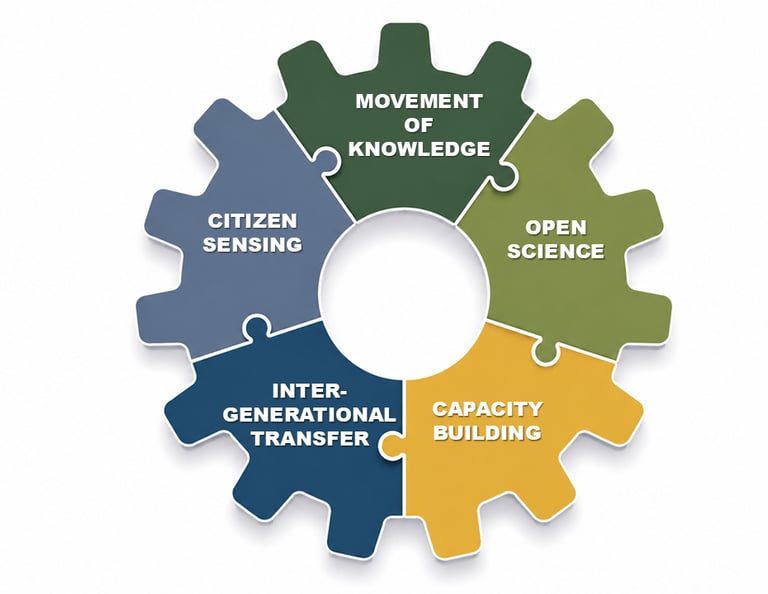
Traditional multiple-helix models of innovation were designed primarily for urban-industrial contexts. Applied to rural territories, they produce a structural blind spot: the living environment itself. Agricultural landscapes, soil systems, biodiversity networks, and climate dynamics are not passive backdrops to rural economic activity. They are co-creators of the conditions in which rural innovation either becomes possible or does not. From this practical experience emerged a five-dimensional rural innovation framework positioning rural resilience as the product of interconnected systems: the movement of knowledge, citizen sensing, inter-generational knowledge transfer, open science, and territorial capacity building operating within living socio-ecological environments.
Freedom of Movement of Knowledge
In April 2024, Enrico Letta’s report to the European Council — Much More Than a Market — proposed the Freedom of Movement of Knowledge. Letta argued that harnessing collective intelligence across Europe, unencumbered by disciplinary or artificial borders, is essential to the continent’s future competitiveness, cohesion, and sustainability. SUSTAINAGRO arrived at the same conclusion independently, through practice, before the report was published. Its focus on Fifth Helix is, in structural terms, an operationalization of Letta’s fifth freedom at the rural territorial scale — building the conditions under which knowledge generated in fields, forests, village kitchens, and community living labs can move openly, fairly, and with full attribution into the shared European knowledge commons, and return as practical innovation to the communities that produced it. For policymakers designing instruments under the next Multiannual Financial Framework: rural living labs operating within a Fifth Helix framework are not merely local good practice initiatives. They are infrastructure for the fifth freedom — nodes in the distributed knowledge architecture that the Letta report identifies as essential to European resilience.
Citizen Sensing / Citizen Science
The Fifth Helix is operationalised through Citizen Sensing and Citizen Science — methodologies that treat knowledge held by farmers, producers, and rural communities as a legitimate and irreplaceable input into research, policy dialogue, and ecosystem development. This is an epistemological position: that people who live and work within a rural territory possess forms of observational, relational, and practical knowledge that no external survey or remote-sensing instrument can fully replicate. These form the foundational basis for SUSTAINAGRO's existence. This insight radiates into every program we design. Curriculum structures, field initiatives, community engagement protocols, capacity-building tracks, and research partnerships are all architected with the Fifth Helix as their scaffold. When the question arises — how should this program be built? — the answer begins, always, with the five strands.
Agricultural Knowledge and Innovation Systems (AKIS) — now a formal requirement of CAP National Strategic Plans — function only as well as the knowledge inputs they draw upon. Citizen Sensing within a Fifth Helix framework substantially expands the evidence base available to AKIS actors, including advisory services, Operational Groups, and Local Action Groups operating under LEADER.
Inter-Generational Knowledge Transfer
Rural knowledge is accumulated, embodied, and — without deliberate structural support — at risk of irreversible loss. The Rural Pact’s Good Practice on Generational Renewal in Rural Businesses situates this within a broader structural crisis: demographic decline, outmigration of younger workers, and the difficulty older generations face in transferring enterprises and tacit knowledge to successors. The European Commission’s Strategy on Intergenerational Fairness (2026) and Strategy for Generational Renewal in Agriculture (2025) both recognise that rural territorial gaps reinforce intergenerational inequalities, and regard te Intergenerational transfer as a territorial resilience mechanism
RURAL PACT — RIGHT TO STAY STRATEGY
“Rural territories can only remain economically viable, socially cohesive, and environmentally sustainable if both young and older people have genuine, dignified reasons to remain. This requires the active transfer of identity, knowledge, and economic agency across generations — so that ruralities are experienced not as places of diminishing opportunity but as living systems worth inheriting.”
ruralpact.rural-vision.europa.eu
SUSTAINAGRO’s Living Lab model treats intergenerational transfer not as a welfare concern to be managed externally, but as an innovation resource to be activated from within. Elder knowledge is primary evidence for the Fifth Helix. The adaptability of younger rural actors is the mechanism through which that evidence becomes productive across future generations. Policy instruments that support mentorship, business succession, and intergenerational co-creation — rather than treating youth and elder rural populations as separate beneficiary categories — are more likely to produce durable territorial resilience.

Contributing to the Future of Research
SUSTAINAGRO recognizes that rural territories are not only sites of production and innovation, but also vital contributors to Europe’s collective knowledge, cultural memory, biodiversity intelligence, and living heritage. Through open science practices and collaborative digital infrastructures, rural communities can play a stronger role in shaping Europe’s shared knowledge ecosystem.
The partnership encourages the ethical documentation, preservation, and dissemination of rural knowledge, practices, research outputs, cultural assets, and innovation case studies through open repositories and European digital platforms such as AIRE, Zenodo, Europeana, and the European Collaborative Cloud for Cultural Heritage (ECCCH). By contributing locally-grounded data, stories, methodologies, audiovisual materials, and research outputs, rural actors help enrich the diversity, visibility, and accessibility of European knowledge and cultural heritage.
This approach supports FAIR and open-access principles while strengthening connections between rural communities, researchers, educators, cultural institutions, and policymakers. It also creates opportunities for inter-generational knowledge exchange, citizen science, community archiving, and the preservation of local identities, traditional ecological knowledge, food cultures, and sustainable land-use practices.
Through collaborative knowledge-sharing and digital participation, SUSTAINAGRO aims to ensure that rural voices, experiences, and innovations are fully represented within Europe’s evolving research, education, and cultural ecosystems — contributing to a more inclusive, resilient, and knowledge-rich European future.
SUBSCRIBE
Subscribe to our newsletter to always be the first to hear about recent news and adventures in Ruralities.
Ruralities Living Lab for Resilient Rural Communities
Sustainability in Rural Enterprises and Innovation
A member of the Social Innovation Stakeholders Network - www.SocialInnovationActions.Org
Social Innovation Actions - PIC 878506012