NATURE-BASED SOLUTIONS
In its "State of Finance for Nature 2021", the United Nations Environment Program states that current annual investment in NBS is $133Billion globally, of which 86% comes from public finance. To meet global targets to limit climate change and halt biodiversity loss, this annual investment needs to triple by 2030 and quadruple by 2050. Therefore, a key priority is developing routes by which NBS can become "bankable" — building models that can be scaled and replicated, blending different sources of finance to become financially sustainable. The three living labs produce a territorial-evidence cascade where NBS innovations are proven at rural sites are systematically transferred through peri-urban interfaces into governance, education, and market systems, addressing the call's identified gap in structured pathways from field-level demonstration to policy-ready and investment-ready adoption.
Most current research revolves around the co-creation of NBSs in urban contexts, overlooking the specificities or recognition of rural areas. In practice, the situation in rural mountain and agricultural areas can be more complex than urban settings — stakeholders' primary interest tends to be reducing risk and finding solutions that are also attractive from an economic point of view, such as business models for farmers and landowners, rather than the multiple co-benefits that tend to be most important for urban stakeholders. Rural NBS interventions span a wide range of ecosystem types and challenges. Examples include natural flood management, restoring natural coastal defences, forest restoration that benefits both biodiversity and rural livelihoods, and agricultural approaches that integrate production and conservation. To genuinely qualify as NBS rather than a green-wash project, actions must be deliberate — with clearly defined goals, partners, beneficiary groups, and management systems — and must consider the social, economic, and environmental conditions before any intervention begins. Learning opportunities, site visits, and "hands-on cases" to demonstrate the durability and effectiveness of NBS are seen as particularly useful when all stakeholders can contribute and meet on equal ground; this creates an atmosphere of trust and understanding that supports finding and implementing solutions.
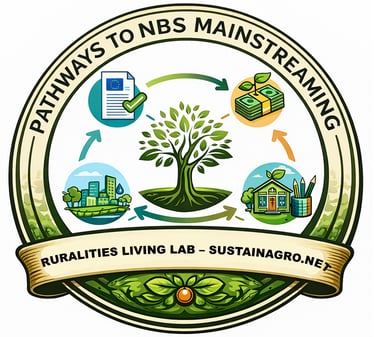
Nature-Based Solutions are actions that work with nature to address societal challenges such as climate change, biodiversity loss, water security, and rural resilience. At the heart of many Nature-Based Solutions are healthy soils, which regulate both blue water—the water flowing through rivers, lakes, wetlands, and groundwater—and green water—the soil moisture that sustains crops, forests, and ecosystems. Acting as a living sponge and filter, healthy soils absorb rainfall, reduce flooding, replenish aquifers, store water for vegetation during dry periods, and support biodiversity. By strengthening the management of both blue and green water, Nature-Based Solutions help rural communities enhance ecosystem health, improve climate resilience, and create sustainable pathways for long-term environmental and economic well-being.
Ruralities Living Lab fosters dynamic socio-ecological systems where soil and water serve as the foundation connecting community engagement, collaborative stewardship, and local knowledge and culture. By strengthening these interconnections, the initiative enhances biodiversity, resilience, and rural prosperity, while positioning Nature-Based Solutions as a common pathway for advancing the EU Green Deal, the Twin Transition, the EU Biodiversity Strategy, and related European Competence Frameworks.
The EU's 137 million rural inhabitants — nearly 30% of the population across more than 80% of its territory — face interlocking pressures: demographic decline, ageing populations, infrastructure deficits, and restricted employment. These dynamics create a self-reinforcing cycle of territorial decline that weakens local economies and accelerates outmigration. The Ruralities Living Lab directly addresses this cycle by positioning rural areas not as declining peripheries but as innovation hubs for Nature-Based Solutions (NBS), creating new economic pathways, skills development, and intergenerational engagement that contribute to a nature-positive, climate-resilient economy while advancing a systemic transition in how rural territories are understood and operationalised — from landscapes under management to engines of socio-economic development and distributed knowledge centres. The Ruralities Living Lab reconfigured as NBS incubators for entrepreneurship, the project transforms land stewardship into a source of innovation, business creation, and high-value employment. Rural communities become not only implementers of NBS, but producers of validated knowledge, technological applications, and market-ready solutions, positioning them at the forefront of Europe’s transition to a nature-positive and climate-resilient economy.
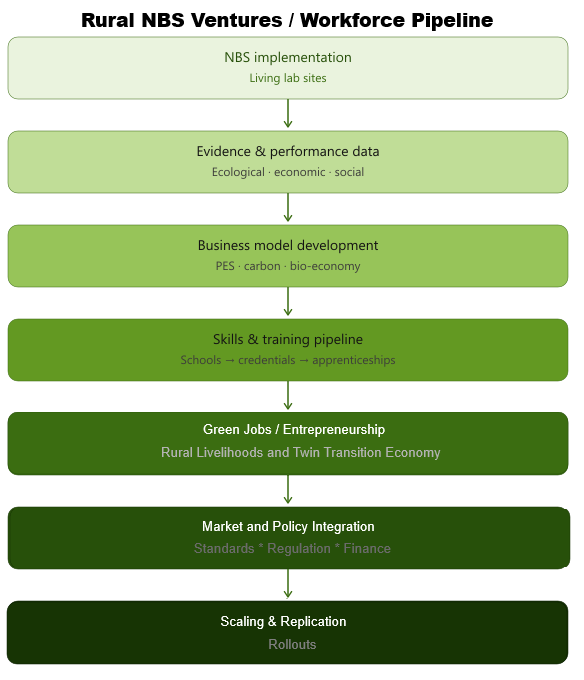
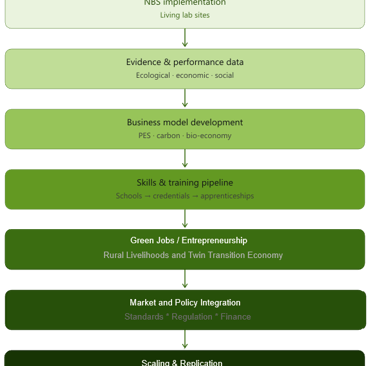
In order to mainstream and scale evidence-based NBSs, living lab methodologies are used to transform rural communities into NBS Innovation & Employment Systems that can simultaneously generate economic value, employment pathways, and decision-ready evidence. The methodology establishes a Rural NBS Venture and Workforce Pipeline, ensuring that site-level NBS implementation is systematically translated into market-ready business models, green jobs, and policy-integrated solutions. At its core, the project advances a systemic transition: from landscape management to engines of socio-economic development and distributed knowledge centers, where rural territories function as innovation hubs, enterprise incubators, and workforce generators within a nature-positive economy.
SUBSCRIBE
Subscribe to our newsletter to always be the first to hear about recent news and adventures in Ruralities.
Ruralities Living Lab for Resilient Rural Communities
Sustainability in Rural Enterprises and Innovation
A member of the Social Innovation Stakeholders Network - www.SocialInnovationActions.Org
Social Innovation Actions - PIC 878506012