SUSTAINABLE TOURISM CORRIDORS
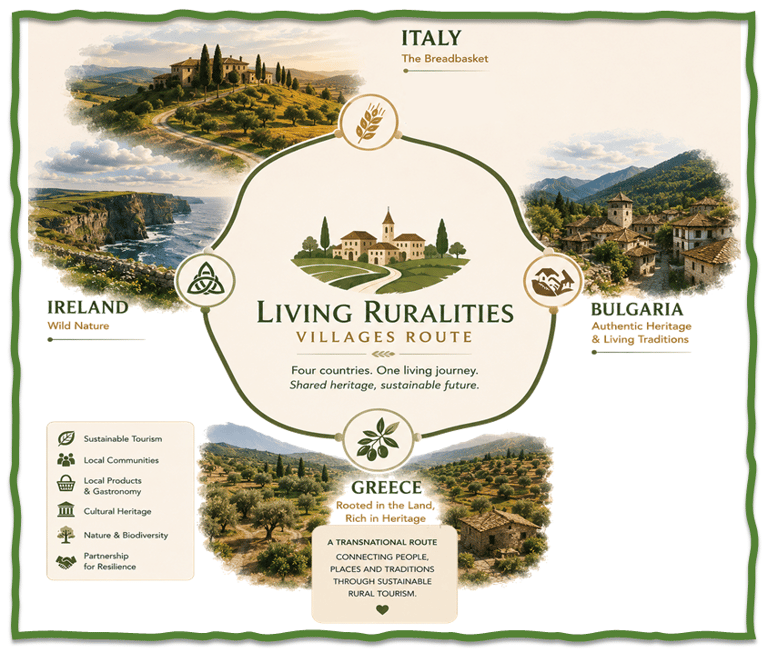
The Living Ruralities Villages Route (LRVR) project promoting RURALITIES RESILIENCE will connect less-visited territories across Italy, Ireland, Bulgaria, and Greece via an integrated transnational sustainable tourism route designed to strengthen the competitiveness, resilience, sustainability, and digital visibility of rural tourism SMEs while reinforcing the long-term vitality of rural communities. The project was conceived in direct response to the conditions under-pinning the Rural Pact’s “Right to Stay” strategy: demographic decline linked to youth outmigration, declining local employment opportunities especially in tourism, and the weak economic spillover reaching smaller municipalities located near established international tourism destinations despite possessing strong agrotourism, gastronomic, cultural, and landscape assets. These challenges are replicated across Europe’s rural territories and are compounded by fragmented tourism ecosystems, weak transnational coordination, limited SME digital maturity, insufficient sustainability-transition support, weak international visibility, and strong seasonality pressures. By transforming dispersed rural assets into a coordinated cross-border route ecosystem, RESILIENT RURALITIES enables SMEs to access wider tourism markets, extend visitor stays, diversify tourism offerings, reduce seasonality dependence, and generate more sustainable local employment opportunities.
The RURALITIES RESILIENCE consortium partners bring expertise in territorial governance, destination management, sustainability education, digital innovation, and community engagement that complement project management and PR/Communications expertise to produce transferable outputs including e-learning pathways, ecosystem mapping, policy briefs, and an open-access Sustainability & Replication Toolkit disseminated through the EU Tourism Platform.
Consortium partners: National Association of Municipal Clerks (Bulgaria), Nomad Nations Network (Estonia), Pomarico Municipality / Lazio DMO of Internal Areas (Italy), Galway Partnership / Atlantic Technical University (Ireland), Ilia Chamber (Greece)
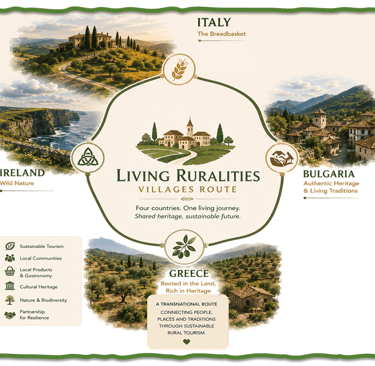
SUSTAINABLE RURAL TOURISM
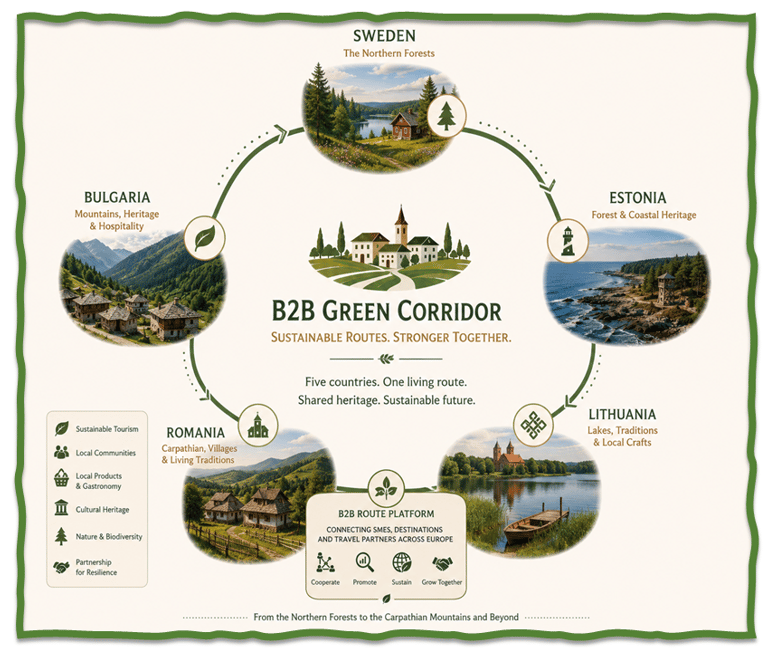
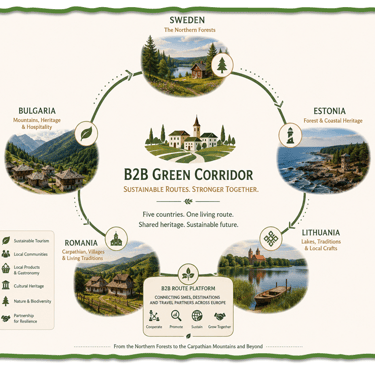
For projects working in rural tourism, agrotourism, and sustainable territorial development, the EU's emerging policy direction originating from the Rural Pact reflects a growing recognition that rural resilience increasingly depends on interconnected territorial ecosystems capable of generating environmental, social, and economic value simultaneously. Supporting the sustainable competitiveness of tourism SMEs in ways that sustain local economies, preserve cultural identity, strengthen biodiversity, and create viable long-term opportunities for social impact in rural communities is a centralized theme of two tourism corridors: Ruralities Resilience and Baltic-to-Balkan Green Corridor. Both combine integrated route development, targeted capacity-building, a multilingual digital booking and destination discovery platform accessible across desktop, tablet, and mobile devices through a Progressive Web Application (PWA), created with accessibility-aware design principles, including mobile usability, simplified navigation architecture, readability considerations, and multilingual visitor information. An ECO Seal sustainability self-assessment framework, stackable e-learning micro-credentials, the EU Digital Education Action Plan initiative DigiEduHack supports an Agrotourism Innovation Challenge co-creating practical digital and sustainability solutions with SMEs, municipalities, researchers, and community stakeholders. Interlocking innovations drive both corridors to constitute a rural tourism ecosystem serving tourism SMEs, Destination Management Organizations (DMOs), Business Support Organizations (BSOs), local authorities, and travelers seeking authentic agro/eco/nature- and slow-tourism experiences. Long-term sustainability rests on a diversified revenue model: a multilingual progressive web application (PWA), certification services, training fees, membership contributions, and collaborative project funding.
Rural communities across the eastern flank of the EU are structurally exposed to economic shocks in ways that urban and coastal tourism destinations are not. The Baltic-to-Balkan (B2B) Green Corridor aligns with the EU’s Tourism Transition Pathway that identifies several priority action areas that are directly implemented. The framework as a whole — not just tourism — is anchored in the idea that sectors cannot navigate the Twin Transition individually; they need ecosystem-level coordination between large and small actors, between public and private, and across borders. This is precisely the architecture that B2BGreen Corridor espouses.
The project establishes a trans-national thematic rural tourism route spanning EU rural territories, linking Boreal and Alpine forests with Baltic and Black Sea fisheries heritage, Central European agricultural traditions, and rich food, cultural, and nature-based tourism assets of Southeast Europe's rural communities. The project creates a living ecosystem connecting rural tourism SMEs along a Forest and Rural Heritage corridor that is geographically and culturally coherent but currently invisible to European and international visitors as a unified destination.
B2B Green Corridor promotes biodiversity, cultural heritage, gastronomy, artisanal knowledge, and community-centred tourism experiences while encouraging slower, lower-impact travel patterns and stronger regional value chains. By connecting rural territories to existing tourism flows and increasing cross-border cooperation between Destination Management Organizations (DMOs), Business Services Organizations (BSOs), technology providers, and capacity-building organizations, the project contributes to more balanced tourism distribution, increased rural resilience, and long-term socioeconomic sustainability across participating regions in Bulgaria, Czechia, Estonia, Finland, Lithuania, Romania, Slovenija, and Sweden.
Consortium partners: Regional Cluster North-East (Bulgaria),Lithuanian Association of Hotels & Restaurants / Darnoje NGO (Lithuania) Lesprojekt (Czechia), Baltic Living Lab / Estonian Business School (Estonia), Tietotalo (Finland), Lithuanian Association of Hotels & Restaurants / Darnoje NGO (Lithuania), DMO Bucovina (RO), Slovenijan Forest Institute (Slovenija), Varmland DMO (SE)
Thus, both corridors contribute directly to the EU Transition Pathway for Tourism, the Long-Term Vision for Rural Areas, and the European Green Deal. They also align with the EU’s Carbon Removals and Carbon Farming Regulation (CRCF) that reveals a growing recognition that Europe’s rural territories are central to the continent’s environmental, economic, and social future. The two corridors are anchored in the PWA enabling direct booking from local providers across the network. By reducing dependence on high-commission intermediaries, the platform retains more tourism revenue in rural communities. This community-benefit revenue-sharing model rebates a portion of commissions to providers who actively generate bookings, creating a self-reinforcing promotional ecosystem. Venture partners access the ECO Seal—a sustainability certification framework for rural micro-enterprises aligned with SDG/EU Twin Transition objectives and offering a pathway toward credentialling programs like Green Key. Certification and renewal fees support ongoing methodology development. Stackable micro-credentials in sustainable tourism, digital marketing, and business management are delivered through e-learning co-developed by venture partners in collaboration with HEIs/VETs, DMOs, BSOs, and chambers of commerce, generating training fees and institutional income.
Where SMP COSME applications are approved, corridors will activate cascade funding calls, enabling SMEs to access grants and mentoring through Living Lab cohorts combining peer learning, technical assistance, and innovation support.
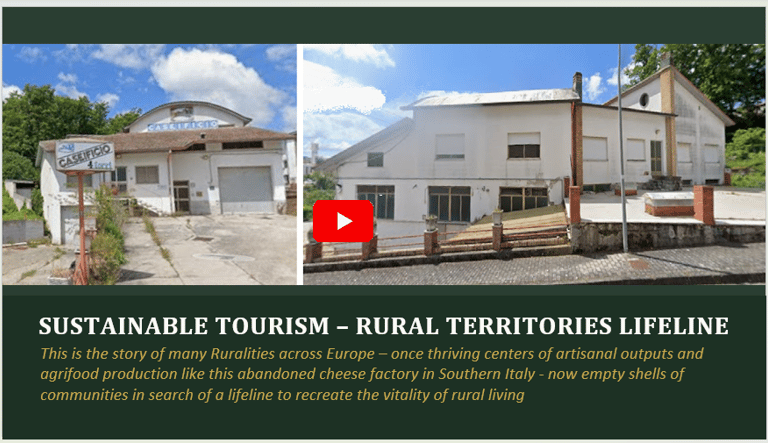
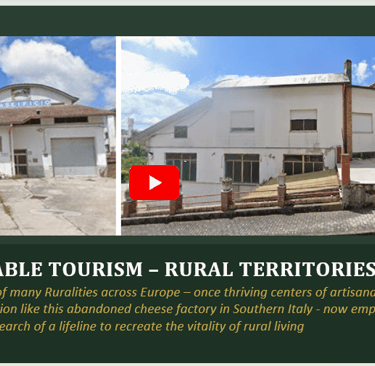
Access the slide deck presentation
Access the 90 second video presentation


SET-Berlin...


SUBSCRIBE
Subscribe to our newsletter to always be the first to hear about recent news and adventures in Ruralities.
Ruralities Living Lab for Resilient Rural Communities
Sustainability in Rural Enterprises and Innovation
A member of the Social Innovation Stakeholders Network - www.SocialInnovationActions.Org
Social Innovation Actions - PIC 878506012