Turning Ideas into Long-Term Impact
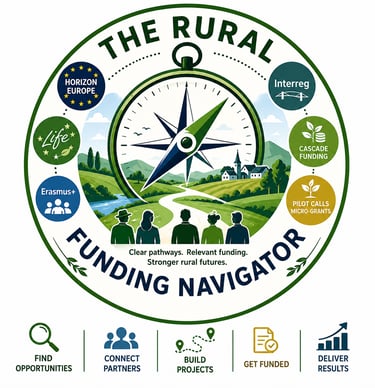
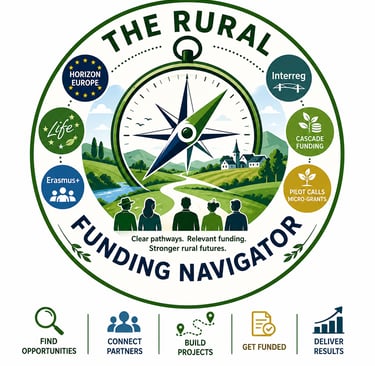
The Rural Funding Navigator helps rural enterprises, communities, and organisations find their way through Europe’s main funding programmes and support mechanisms. It turns complex funding systems—often spread across different EU initiatives—into clear, practical pathways for action. From Horizon Europe and LIFE to Erasmus+ and Interreg, funding opportunities are translated into accessible entry points tailored to rural realities. Instead of searching through fragmented calls and technical documents, users can quickly understand what is relevant, what is realistic, and what steps to take next. The Ruralities Living Lab provides its members a guided system designed to support decision-making, partnership building, and project development in rural areas. It highlights entry points such as cascade funding, pilot calls, and micro-grants, while also helping users identify potential partners and project pathways.
The goal is simple: to reduce barriers between rural innovation and European funding, and to make participation in EU programmes more accessible, collaborative, and actionable.
Whether you are a small rural business, a cooperative, a municipality, or an emerging rural initiative, the Rural Funding Navigator helps you move from idea to funded project with greater clarity and confidence.
Area A — Risk resilience through ecosystem restoration. This includes floods, droughts, water retention, floodplains and free-flowing rivers. At least one Living Lab must address water resilience against floods/droughts, and at least one must address fire-risk management in agriculture and forestry. Post-disaster ecosystem restoration is also required. CORDIS
Area B — Restoration through biodiversity-friendly farming and forestry. This includes agroecology, agroforestry, grazing-based grasslands, organic farming and high-diversity landscape features. At least one Living Lab must develop/test tools supporting in-situ conservation of genetic resources and sustainable use of agrobiodiversity and/or forest biodiversity, with farmer/forester-informed data systems. Citizen science is explicitly mentioned as appropriate
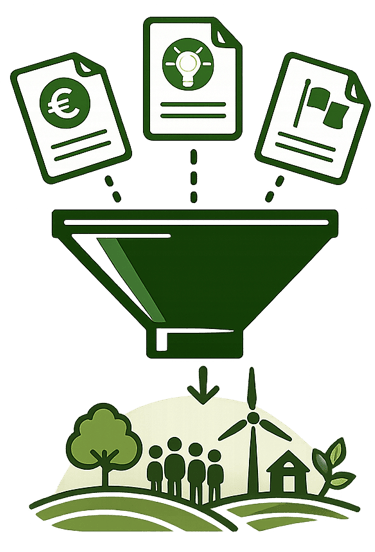
Navigate the European funding landscape to find funding that best aligns with project goals and objectives
Focus grantwriting efforts on the most relevant funding opportunities
Develop a strategic pipeline of future grant applications for better use of precious time and resources
WIDERA - Support for Widening Countries
Getting Ready for Submission
WIDERA—Widening Participation and Strengthening the European Research Area—has two main components:
Widening participation and spreading excellence: reducing disparities in research and innovation capacity between countries and regions.
Reforming and enhancing the European Research Area (ERA): improving how European research is governed, shared, financed and connected with society.
The second component is organised around four ERA pillars. Forthcoming calls to be announced in December, 2026 for March submissions.
Actively Seeking WIDERA-based partners Email Reference:


POLICY ENLARGE...
Closes 03/05/2028 - Policy Enlarge - Funding Instrument 1 (Small Grants for Joint Regional Innovation Actions)
Funding small cross-border joint regional innovation actions that strengthen R&I cooperation, capacity and policy alignment among enlargement countries and support their integration into EU R&I actions and policymaking
Max funding per project: 8.000€
HORIZON..
17 Jan 2027 - Transformative change towards a nature-positive economy and society.” It cuts across biodiversity/restoration priorities and is part of the 2026–2027 Horizon work programme.
Recent Submissions
A Multi-Level Skills Alliance for Europe’s Twin Transition Readiness
TT-Bridge is an Erasmus+ Alliances for Education and Enterprises project that connects enterprises directly to curriculum that contributes to workforce preparedness for the Twin Transition, the EU’s goals for decarbonization and digitalization. Labor-market actors co-define what green-digital competence looks like, validate challenge-based learning modules, and endorse the resulting micro-credentials. Those credentials are EQF-mapped, Europass-compatible, and recognized across consortium institutions in EU Member States. Thirteen partners from Bulgaria, Czechia, Estonia, Finland, Greece, Ireland, Italy, Netherlands, Spain
Baltic-to-Balkan Green Corridor
The B2B Green Corridor COSME project supports sustainable competitiveness of tourism SMEs by connecting less-visited territories across Sweden, Finland, Estonia, Lithuania, Romania, and Bulgaria via an integrated transnational sustainable tourism route. The project was designed to strengthen the competitiveness, resilience, sustainability, and digital visibility of rural tourism SMEs and Destination Management Organizations while reinforcing the long-term vitality of rural communities. A Financial Support to Third Party process will be issued for targeted countries in 2027 Consortium led by the Regional Cluster North-East (Bulgaria) with partners Baltic Living Lab (Estonia), Tietola (Finland), Estonian Business School, Lithuanian Hotels & Restaurants Association, DMO Bucovina (Romania), DMO Varmland (Sweden)


Expertise Behind Each Submission
Competitive European proposals are built through a process that begins well in advance to the submission deadline, extends far beyond identifying a suitable funding call, and having the people with the right skills craft the application. Equally important is the ability to convene the right consortium, align diverse partners across borders and around a shared vision, to transform complex ideas into coherent, credible, and implementable project frameworks capable of meeting highly competitive European evaluation standards.
Equally important is the ability to convene the right consortium. Successful applications depend on building balanced partnerships that combine technical expertise, geographic diversity, implementation capacity, communication strength, and long-term sustainability. We work closely with municipalities, universities, SMEs, NGOs, rural organisations, and sector specialists to create collaborative partnerships capable of delivering meaningful impact.
In reality, coordinating a large European proposal often becomes a temporary multinational operation. Over months of development, partners across countries and sectors must align visions, contribute specialised expertise, resolve competing priorities, build coherent work plans, structure budgets, and respond to evolving programme expectations — all within demanding timelines and highly competitive funding environments.
From there, the process becomes one of strategic storytelling and precision. Preparing a competitive European application requires not only technical knowledge and project-design capacity, but also an advanced command of professional English capable of translating complex ideas into clear, persuasive, and policy-aligned narratives. Every proposal must align closely with programme priorities, evaluation criteria, work package logic, budget structures, expected impacts, and measurable outcomes. Strong applications require innovation and vision, but equally clarity, coherence, credibility, and the ability to communicate ambitious concepts in language that is both technically rigorous and accessible to evaluators from diverse disciplinary and cultural backgrounds.
Finally, submission itself demands careful coordination, compliance management, document preparation, budgeting accuracy, partner validation, and technical oversight within complex European submission systems. Much of this work remains invisible once a proposal is submitted. Yet behind every application stands an extraordinary amount of collaboration, persistence, expertise, and commitment dedicated to transforming ideas into projects capable of generating durable social, environmental, educational, and economic impact.
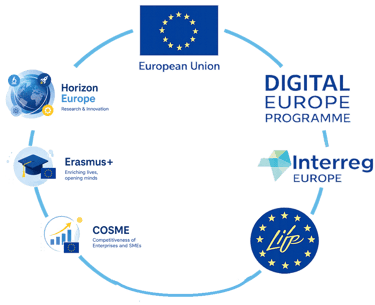
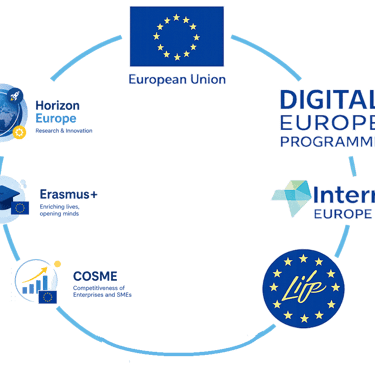
Behind every successful grant application is far more than writing alone. It begins with identifying the right funding opportunity at the right moment; this requires an understanding about not only what a program funds, but why the call exists, what policy objectives it supports, and where genuine gaps or opportunities remain. Our team includes professionals with Master’s and PhD-level academic backgrounds and native English-language proficiency, enabling the preparation of technically rigorous, strategically aligned, and linguistically sophisticated European project applications. They have developed strong expertise in navigating European funding ecosystems, from SMP COSME, Horizon Europe and Erasmus+ to LIFE, Interreg, and Digital Europe. This involves researching complex call documents, analyzing evaluation criteria, monitoring emerging policy priorities, and translating ambitious ideas into realistic, fundable project concepts - in English
Grow, diversify, and future-proof operations While nurturing inter-generational Knowledge Transfer
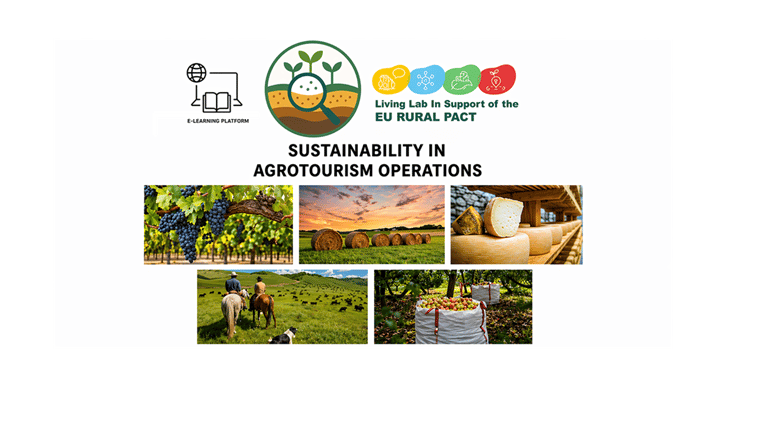


FARM-TO-FORK
Linking soil health and ecological farming practices to premium, market-ready products
SUSTAINABLE TOURISM
E-Learning and Eco-Seal Certification for transparent environmental monitoring
HANDS-ON LEARNING
Dialogue series built at the intersection of soil science, farming, food, culture, and societal values.
SUBSCRIBE
Subscribe to our newsletter to always be the first to hear about recent news and adventures in Ruralities.
Ruralities Living Lab for Resilient Rural Communities
Sustainability in Rural Enterprises and Innovation
A member of the Social Innovation Stakeholders Network - www.SocialInnovationActions.Org
Social Innovation Actions - PIC 878506012