Community Action Group
WHAT ARE MULTI-ACTOR PLATFORMS (MAPs)?
Multi-Actor Platforms (MAPs) bring together the multiple helix of rural development—public authorities, businesses, entrepreneurs, researchers, educators, civil society organizations, and citizens—to identify local challenges, co-create solutions, and shape pathways toward more resilient rural futures.
Rather than implementing top-down programming, MAPs function as collaborative spaces for dialogue, experimen-tation, and action. They connect local knowledge with research, policy, and innovation, ensuring that rural development priorities are shaped by the people and organizations most affected by them. The Ruralities Living Lab CAG serves as the umbrella network supporting the founding partners of the Ruralities Living Lab MAP:
Social Innovation Action (Estonia)
Regional Cluster North East (Bulgaria)
Municipality of Pomarico (Italy)
Lithuanian Association of Hotels & Restaurants
Ilia Chamber (Greece)
Baltic Living Lab (Latvia)
Lazio Area Interna - 19 rural municipalities (Italy)
Visit Varmland DMO (Sweden)
Local Action Group GAL Molise (Italy)
National Association of Municipal Clerks (Bulgaria)
Darnoje (Lithuania)
Molinara Innovation Center (Italy)
Bucovina DMO (Romania)
Living Labs Network (Italy)
Bonolab (Denmark)
Together, these and other MAPs in rural territories across the EU form a growing network of rural innovation ecosystems that transform local experience into collective knowledge, local action into European collaboration, and local priorities into contributions to the wider Rural Pact agenda.
The Ruralities Living Lab CAG constitutes a Multi-Actor Platform (MAP) with satellite members located through Europe's rural territories. The MAP is the forum for ongoing exchanges of ideas for co-learning and co-creation of knowledge at local, regional, and European levels. MAPs are embedded in the broader evolution of the interfaces between science, policy and society within the EU, paving the way for both cross-disciplinary and cross-sectoral engagement.
European governance demonstrated by increasingly recognizes that addressing complex societal challenges requires stronger science-society-policy interactions. While scientific knowledge continues to advance, translating evidence into action often remains constrained by fragmented stakeholder engagement, limited citizen participation, and weak mechanisms for integrating local knowledge into decision-making. As a result, participatory approaches such as Living Labs, Multi-Actor Platforms, citizen science, and co-creation processes have become central instruments for strengthening evidence-informed policymaking and societal uptake across Europe.This is what the Ruralities Living Lab aims to address through the creation of its MAP network, whose members gain access to peer learning, shared methodologies, digital tools, collaborative projects, policy dialogue opportunities, and transnational partnerships.
OUR LEARNING AGENDA
The Ruralities Living Lab Community Action Group serves as a science–society–policy interface where rural communities, entrepreneurs, researchers, public authorities, and civil society work together to co-create solutions for resilient rural futures. Our mission is to transform local knowledge, lived experience, and research evidence into practical action and policy influence. Through Living Labs, Multi-Actor Platforms, and transnational cooperation, we explore how rural territories can strengthen their capacity to thrive in the face of demographic, economic, environmental, and technological change. Key questions guiding our work include:
How can rural communities create meaningful livelihoods that make the Right to Stay a realistic option?
How can tourism, agriculture, food systems, and nature-based solutions work together to strengthen local economies?
What conditions enable rural entrepreneurs and SMEs to innovate, collaborate, and grow?
How can local knowledge and community voices better inform regional, national, and European policy?
What governance models best support community-led rural development and social innovation?
How can Living Labs accelerate the transition to sustainable, resilient, and inclusive rural territories?
By connecting local experimentation with European dialogue, the Community Action Group seeks not only to identify solutions, but to create a growing movement of rural actors shaping the future of Europe's rural territories together.
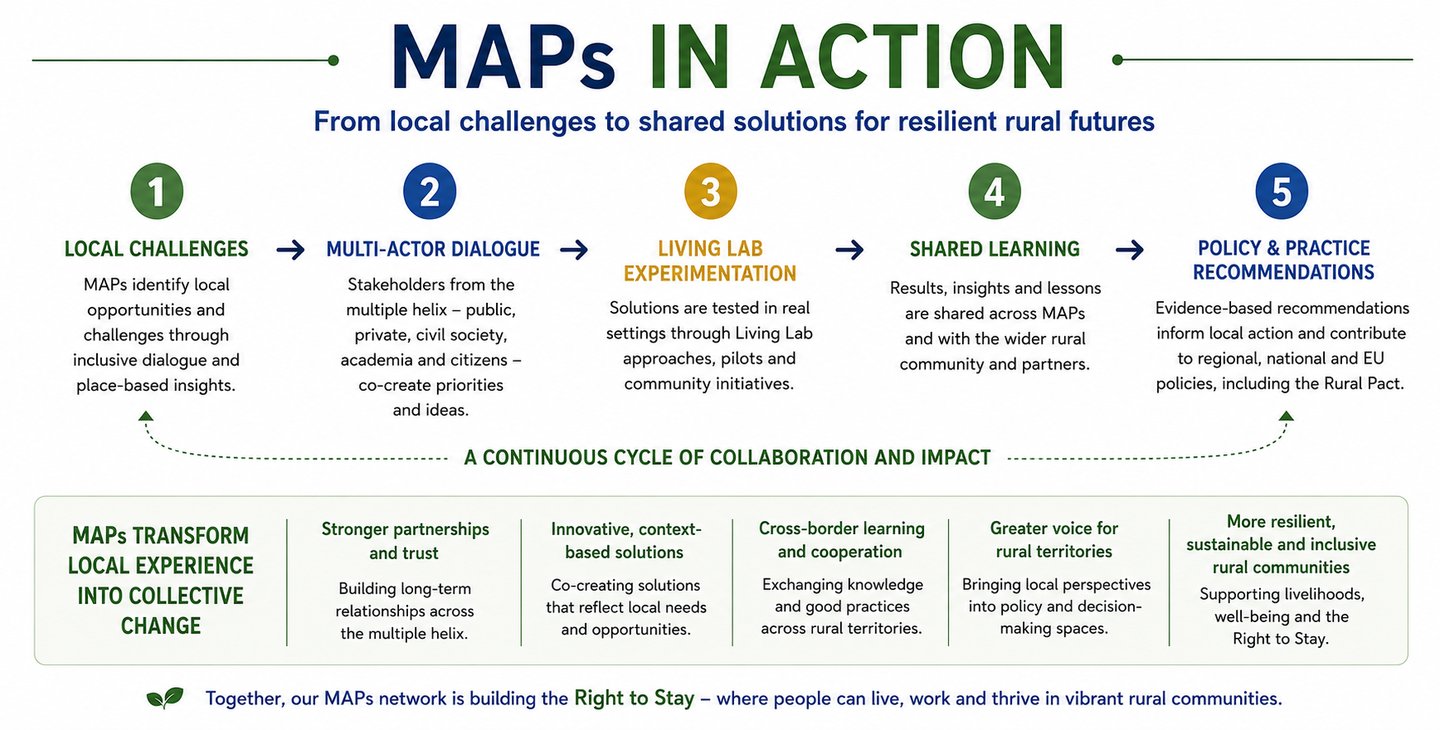
The Ruralities Living Lab Community Action Group serves as a Multi-Actor Platform (MAP) for Europe to explore the challenges and opportunities shaping the future of rural territories. Through dialogue, experimentation, and collaboration, our members connect local priorities with European policy, research, and innovation agendas.
Rural Entrepreneurship - Essential driver of rural vitality, innovation, and local economic resilience
Learning Together
Through our Community Action Group and its Multi-Actor Platforms, we connect local experience with shared learning, Living Lab experimentation, and policy dialogue. Together, we seek practical pathways toward resilient, inclusive, and prosperous rural territories across Europe.
How can citizens, businesses, researchers, and policymakers collaborate more effectively?
What governance models support community-led development?
How can local priorities influence regional, national, and European policy
How can Multi-Actor Platforms strengthen rural voices in decision-making?
What support ecosystems enable rural entrepreneurs to succeed?
How can access to skills, mentoring, finance, and markets be improved
What barriers prevent under-represented groups from starting businesses?
How can entrepreneurship strengthen local value chains and community wealth?
Rural Governance - Strong governance enables communities to shape their own futures.
How can tourism generate year-round opportunities in rural territories?
How can less-visited destinations capture greater tourism value?
How can tourism support local food systems, cultural heritage, and biodiversity?
What models best balance growth with environmental and social sustainability?
Right to Stay - The ability to remain, work, and thrive in rural territories is fundamental to resilient communities.
Sustainable Tourism - Should create value not only for visitors, but also for local people, culture, and landscapes
How can rural communities create meaningful livelihoods and quality jobs?
What conditions encourage younger generations to remain or return?
How can rural territories retain talent, skills, and entrepreneurship?
What role can tourism, agriculture, and social innovation play in reversing outmigration?
Nature-Based Solutions - Healthy soils, water systems, forests, and ecosystems are the foundation of long-term rural prosperity
How can Nature-Based Solutions (NbS) strengthen climate resilience?
What role do soils play in regulating blue and green water resources?
How can ecosystem restoration create economic opportunities?
How can communities participate in environmental stewardship and biodiversity protection?
Belonging is Infrastructure - Resilient rural territories are built not only through physical and economic assets, but through the relationships, rituals and traditions, identities, and shared experiences that connect people to place that creates a sense of community.
How can rural communities cultivate a stronger sense of belonging and local identity?
What cultural practices, traditions, and community spaces help people feel rooted in place?
How can intergenerational knowledge and local heritage be preserved and reimagined for future generations?
What role does belonging play in supporting the Right to Stay and long-term rural resilience?
How can communities co-design solutions to local challenges?
What approaches strengthen inclusion, wellbeing, and social cohesion?
How do Living Labs methodologies support experimentation and learning?
How can innovation emerge from local knowledge and community assets?
Social Innovation - Complex rural challenges require new forms of problem solving in opportunities for collaboration and participation
SUBSCRIBE
Subscribe to our newsletter to always be the first to hear about recent news and adventures in Ruralities.
Ruralities Living Lab for Resilient Rural Communities
Sustainability in Rural Enterprises and Innovation
A member of the Social Innovation Stakeholders Network - www.SocialInnovationActions.Org
Social Innovation Actions - PIC 878506012